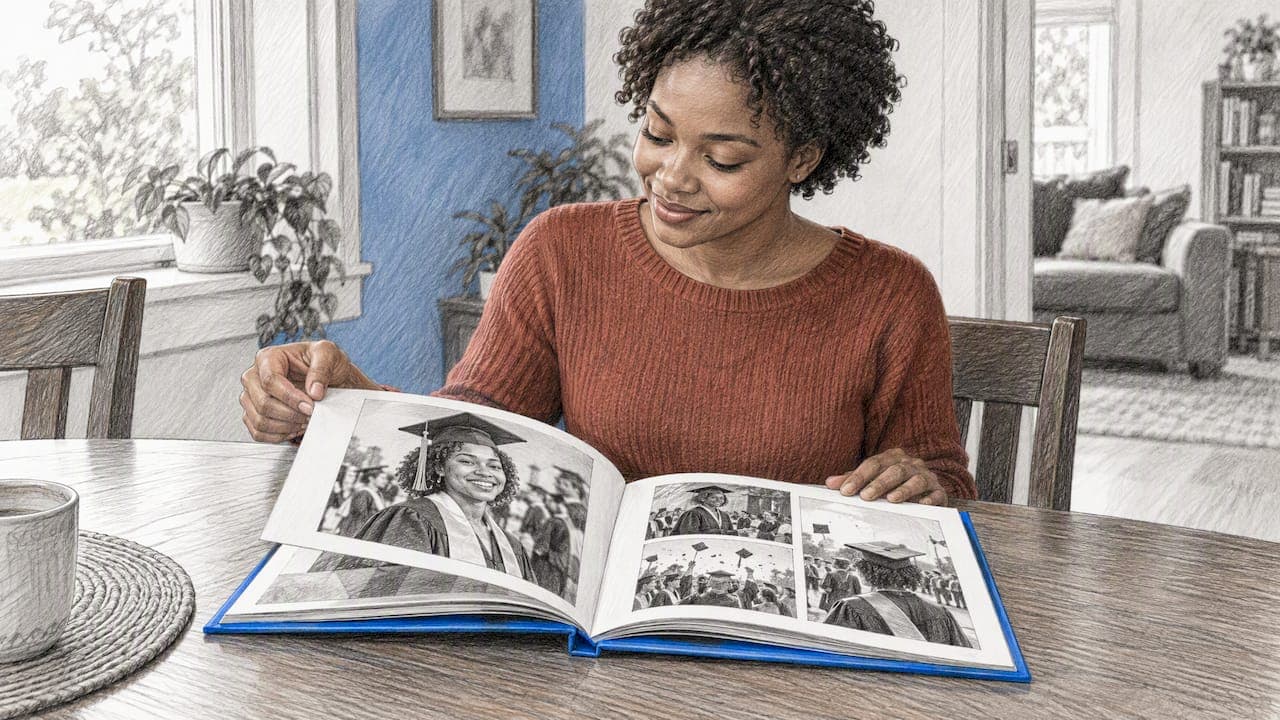
The best graduation photo book is not a pile of cap-and-gown snapshots. It is a short story of the graduate’s school years, told with photos from many people and filled with their words. Pick a clear scope (the day, the senior year or the whole journey), collect photos and messages from family, friends and teachers, and keep the layouts simple. This guide shows you how, page by page, including what to write when you are asked to leave a message.
Key Takeaways
- Choose one scope first: graduation day, senior year, or the full journey from kindergarten. Everything else gets easier.
- The most meaningful pages are rarely your own photos. They are the messages, advice and voice recordings from the people around the graduate.
- Collect contributions through one link or QR code so nobody needs an app or an account, then let templates handle the layout.
- Keep pages simple: one focal photo, a short caption, plenty of white space.
- Order early. A printed hardcover needs production and shipping time, and graduation dates do not move.
Table of Contents
- Why a graduation photo book beats a folder of pictures
- Decide the scope before you pick a single photo
- Build a shot list of people, places and moments
- Photo album ideas that give the book structure
- What to include in a graduation memory book
- Graduation guest book ideas: let everyone contribute
- What to write in a graduation memory book
- Planning a group graduation gift without the chaos
- How Pomento turns everyone’s memories into a graduation gift
- Digital, printed or both?
- Common mistakes to avoid
- FAQ
- Sources
Why a graduation photo book beats a folder of pictures
Most graduation photos end up in a camera roll, a group chat or a shared album nobody opens again. A book gives them an order and an ending. It also gives relatives who could not attend a way to be part of the day.
The milestone is a big one for families. According to the National Center for Education Statistics, the average on-time graduation rate for U.S. public high school students rose from 80 percent in the 2011–12 school year to 87 percent in 2021–22. Millions of families mark this moment every year, and many want something more lasting than a framed photo.
The same logic applies to college, trade school and even kindergarten or eighth-grade ceremonies. If a chapter of life is closing, a book can hold it.
Decide the scope before you pick a single photo
The biggest mistake is starting with the photos. Start with the question: what is this book about?
Option 1: The day itself
This is the easiest book to finish. It covers getting ready, the ceremony, the diploma moment, family portraits and the party. Twenty to thirty good photos can carry it. It suits last-minute gifts and graduates who do not have much archive material.
Option 2: The senior year
Here you follow a school year: the first day, homecoming, prom, the last game, finals, senior week, graduation. Photos come mostly from the graduate’s friends, so it works well as a group project.
Option 3: The whole journey
This is the book that makes parents cry. Divide it into chapters (elementary, middle, high school or college), and show firsts and lasts side by side: the first-day-of-school photo next to the last-day one, the same backpack, a very different height. It takes more digging through old albums, so give yourself a few weeks.

Write your choice in one sentence, such as “Four years of high school, through the eyes of the people who were there.” That sentence becomes your filter: if a photo does not fit, it stays out.
Build a shot list of people, places and moments
A short list prevents the book from becoming five hundred near-identical ceremony pictures. Think in categories:
- People: parents, siblings, grandparents, best friends, teammates, a favorite teacher, a coach, a mentor.
- Places: the school entrance, the locker, the field or stage, the bedroom desk where the studying happened, a favorite hangout.
- Achievements: awards, honor roll letters, a team trophy, a performance, a science fair project, a first job.
- Traditions: the senior photo, the cap decorating, the family dinner, the cap toss.
- Small proof of personality: a doodled notebook, a ticket stub, a ridiculous haircut.
Then ask where the photos live. Phones of parents and grandparents, older siblings’ accounts, school yearbook pages, coaches’ team photos and shoeboxes in the closet are all good sources. Scanning an old print takes a minute and is often the best page in the book.
Photo album ideas that give the book structure
Once you have material, choose a structure. These work well and none needs design skills.
- Four Years in 40 Photos. One photo per month or per season, with a one-line caption each.
- First versus last. First day and last day, first game and last game, first car ride to school and the last one.
- Chapters by passion. One spread each for sports, music, theater, clubs, friends and academics.
- A thank-you section. Pages dedicated to the teachers, coaches and relatives who helped, ideally in their own words.
- The ceremony sequence. A cover, a formal portrait, getting ready, the ceremony, the diploma moment, the celebration and a closing page with the graduate’s own note or favorite quote.
- Looking ahead. A last chapter for the next step: dorm photos, a first-job outfit, a travel plan, or simply blank space for goals.
Layout rules that keep it readable
- Give each page one focal image and let smaller photos support it.
- Use consistent grids and generous white space.
- Give big events a full page or a spread.
- Keep captions short: names, place and a year are often enough.
- Use the school colors or the graduate’s favorite color for accents, and put the graduate’s name, school and year on the cover.
- Alternate photo-heavy pages with pages of text, quotes or a scanned memento.
Sketching the page order on paper before you design saves a lot of rearranging later.
What to include in a graduation memory book
A good memory book has a spine of photos and a heart of words. Include:
- a dedication page from the person organizing the book;
- the ceremony and class photos;
- achievements and extracurriculars;
- milestones and funny stories (the inside jokes matter);
- messages from family, friends, teachers and coaches;
- a look at the future: plans, hopes, advice.
Narrative beats volume. A book that moves from where the graduate started, through the challenges and lessons, to what comes next feels like a story. A book that simply dumps every photo feels like a camera roll in print.
Graduation guest book ideas: let everyone contribute
The traditional guest book is a notebook on a table that sits half-empty, and then disappears into a drawer. It misses the relatives who could not come and the friends who only think of something good to say two days later. Here are better ideas.
Ask for something specific
A blank page invites “Congrats!” Prompts invite stories. Try one of these on a card, in the invitation or in the message you send with the link:
- Share your favorite memory with the graduate.
- What is one piece of advice you wish you had at this age?
- Finish the sentence: “I always knew you would…”
- What is the funniest thing you remember from the last four years?
- Upload one photo that shows who they are.
Collect before the party, not only at it
Messages sent in the weeks before graduation let you build the book as a surprise. Messages collected at the party catch the energy of the day. Doing both means the book includes the people who live far away and the people at the table.
Include voices and video
A grandparent’s recorded blessing or a younger sibling’s silly voice message is worth ten typed lines. Because the graduate can play them back years later, these often become the part they treasure most.
Remove friction for guests
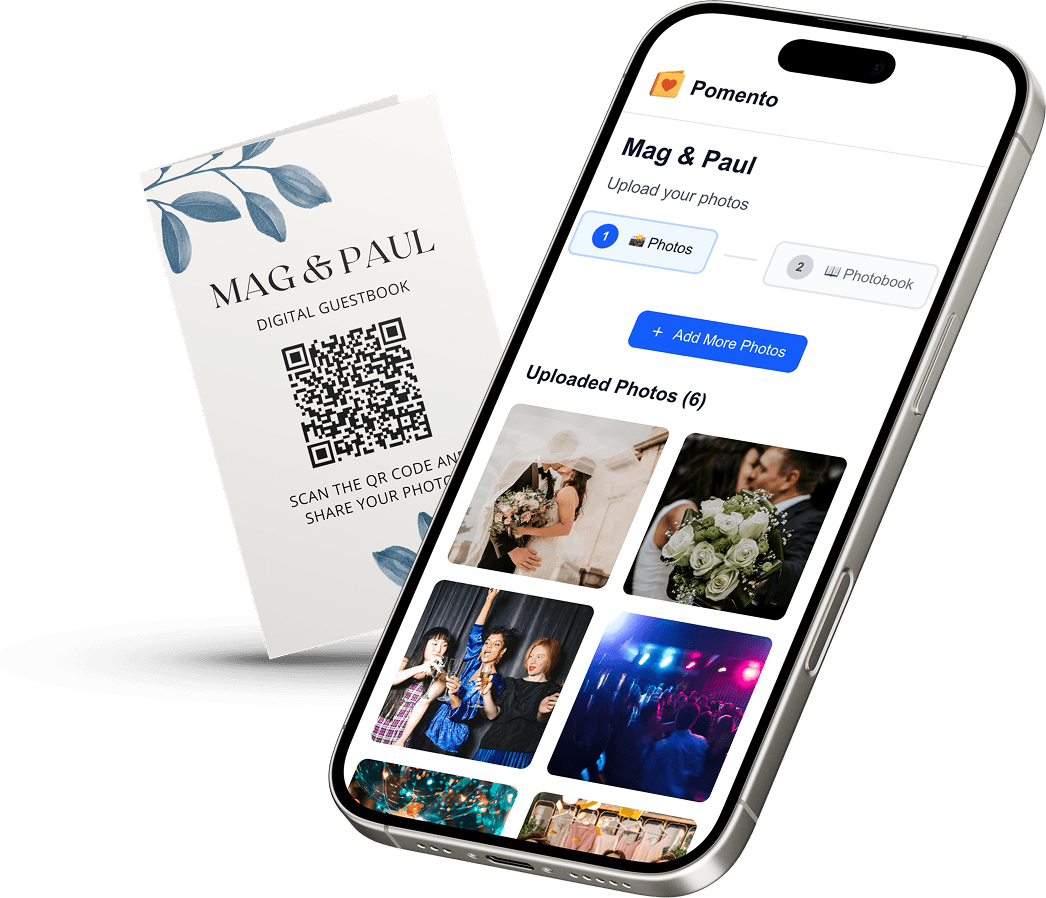
The more steps you ask of a guest, the fewer messages you will get. Download an app, create an account, remember a password: every one costs you contributions, especially from grandparents. A single link or QR code that opens in any phone browser is the simplest approach.
What to write in a graduation memory book
If you are the one writing the message, the pressure to be profound is the real obstacle. Use a simple formula: one memory, one quality, one wish.
- A memory: “I still remember you rewriting your essay at midnight and refusing to give up.”
- A quality: “That stubborn streak is going to take you far.”
- A wish: “I hope the next chapter is as much fun as the last.”
Graduation message ideas by relationship
From a parent: “We watched you walk across that stage and saw every version of you at once: the toddler, the kid, the person you are now. We are proud of who you are, not only what you achieved.”
From a grandparent: “When I was your age, nobody could have told me how fast time moves. Spend it on people you love and work you believe in.”
From a sibling: “You made it, and I will not say how many times I borrowed your hoodie. Call me when you need a break. I will always pick up.”
From a friend: “Nobody else will ever understand our lunch table jokes. Wherever you go, I am coming to visit.”
From a teacher or coach: “You asked the questions other people were afraid to ask. Keep doing that.”
From a classmate: “Thank you for the group-project rescues and the late-night study playlists. Good luck out there.”
Short messages that still land
- “Proud of you today and every day.”
- “The world is lucky to get you next.”
- “Close one door, open a hundred.”
- “You did the hard part. Now go enjoy it.”
Life advice that is not a cliché
Advice lands when it is specific. “Say yes to the first invitation in a new place.” “Learn to cook one great meal.” “Call your grandparents.” “Save a little from your first paycheck.” Share what you honestly learned rather than a poster quote.
Planning a group graduation gift without the chaos
When friends, classmates, parents and teachers all want to contribute, the usual way is a group chat, with photos scattered over six phones and someone doing the layout at 1 a.m. It works, but it is the reason many books never get made.
A workable plan:
- Pick an organizer and a deadline. Aim for about three weeks before the ceremony if you want a printed book in hand on the day.
- Send a single link or QR code. Put it in the group chat, a graduation invitation or a printed card.
- Give a prompt. One sentence saying what you want: a photo, a message, advice.
- Send one reminder. A few days before the deadline, nudge the quiet people.
- Review and order. Check the pages, then choose digital, printed or both.
The same approach works for other celebrations, from birthdays to farewells, and the occasions page on Pomento shows the range.
How Pomento turns everyone’s memories into a graduation gift
Pomento is an all-in-one collaborative memory platform and digital guestbook for weddings, birthdays, baptisms, memorials, farewells and company events, and it fits graduations just as well. The idea is to collect everyone’s memories in one place instead of scattered across phones and group chats, then turn them into a gift you can see, hear and hold.
Here is how it works for a graduation:
- Collect. You share one link or QR code. Guests upload photos, videos, written messages and voice messages from any phone or computer. They need no app installation and no sign-up.
- Design. Each guest creates their own photo book page with their photos, words and voice message, using ready-made templates in just a few taps. You do not do the layout.
- Receive. Pomento brings the pages together into a Printed & Digital Photo Book (an interactive digital book to share online and a high-quality printed hardcover shipped to your door), a Personalized Song built from the guests’ words with its own Music Video, and an Event Slideshow for screens and projectors at the party. You also get downloads of all the original photos, videos and voice messages.
It works as a shared surprise gift before the event and as a live guestbook during the celebration, so you can show the slideshow at the party while guests keep adding memories. That is the difference between a file download and a gift the graduate can hold.
Pricing is a one-time payment with no subscription. The Digital Experience is $48 and the Digital + Printed Book is $87. There is no free trial, but every purchase comes with a 14-day money-back guarantee.

Want to see what the result looks like? Preview a real Example Photo Book on Pomento, or start your own project at pomento.com.
Digital, printed or both?
| Format | Best for | Consider |
|---|---|---|
| Digital book | Relatives abroad, quick sharing, voice messages that play back | Nothing to hold on a shelf |
| Printed hardcover | A keepsake for the desk or the family shelf | Needs production and shipping time |
| Slideshow | The party, a screen at the venue | Lives for the event itself |
| Personalized song and music video | Last-minute emotional gift, easy to share | Best with plenty of guest words to draw from |
If the budget allows, do both digital and print: the digital version travels to everyone, the printed one stays with the graduate.
Common mistakes to avoid
- Starting too late. Printing and shipping take time. Order well ahead of the ceremony.
- Too many near-duplicates. Choose the best of ten similar shots.
- Low-resolution photos. Ask contributors to send the original file, not a screenshot of a chat.
- No names or years. A caption you skip today is a mystery in ten years.
- Forgetting the quiet contributors. Teachers and grandparents often write the most meaningful messages, but they need a nudge.
- Cramming. White space is a feature, not a flaw.
FAQ
What should I put in a graduation photo book?
Include a dedication, ceremony and class photos, achievements, clubs and sports, favorite friends, funny moments and messages from loved ones. Finish with a page about what comes next. A clear theme, such as the senior year or the full school journey, keeps it focused.
How many photos do I need?
A day-focused book can work with 20 to 30 strong photos. A multi-year book usually needs more, but quality matters more than quantity. One standout image per page with a short caption looks better than a crowded grid.
Can guests contribute without downloading an app?
With Pomento, yes. Guests use one link or QR code and upload photos, videos, written messages and voice messages from any phone or computer, with no app installation and no sign-up.
What should I write in a graduation memory book?
Share one specific memory, one thing you admire about the graduate and one wish for the future. Keep it short and honest. A single true story beats a long generic paragraph.
When should I start making the book?
Start at least three to four weeks before graduation if you want a printed copy in hand on the day. Collect messages first, then choose the layout, since the contributions shape the story.