The best graduation memory book is not a pile of photos. It is a short story of the graduate’s journey, told by the people who were there: a clear structure, a few big moments, and plenty of words from family, friends and teachers. You can make it as a printed photo book, a signed guest book, a scrapbook, or a shared digital book that everyone adds to. The ideas below cover all of them, plus the layouts and prompts that make each one feel personal.
Key Takeaways
- Choose one angle first: the day, the journey, a passion, or messages from people. A book with a point is easier to build and more fun to read.
- Give the book a beginning, middle and end, with graduation day as the finale, and leave white space on the pages.
- Messages are what make a grad book special. Ask guests specific questions instead of “write something nice.”
- A collaborative book saves the organizer from chasing photos across phones and group chats. With Pomento, guests contribute through one QR code or link, with no app and no sign-up.
- Store a printed book flat, cool, dry and out of sunlight, and keep a digital copy as a backup.
Table of Contents
- Start with the angle, not the photos
- 12 graduation memory book ideas
- How to structure the book
- Making a graduation guest book with photos
- What we built for this: Pomento
- Prompts that get real messages
- Make it personal without making it complicated
- Keeping the book for decades
- FAQ
- Sources
Start with the angle, not the photos
Most graduation books stall because the organizer starts by scrolling through thousands of pictures. Start with a single sentence instead: what is this book about? Four angles work for almost any graduate.
- The day. Cap and gown, the ceremony, the family dinner, the party. This is the simplest option and works well for a last-minute gift.
- The journey. From the first day of kindergarten, high school or college to the walk across the stage. This suits parents and grandparents who have the old photos.
- The passions. Sports seasons, band, robotics, theater, part-time jobs, a car, a dog. This is the best choice for a grad whose life was mostly one or two things.
- The people. Letters, advice and stories from everyone who helped along the way. This is the angle that turns a photo album into something a person rereads on a hard day ten years from now.
You can combine them, but pick a lead. A book that is mostly the journey with a closing section of messages feels deliberate. A book that tries to be all four equally feels like a camera roll in a hardcover.
12 graduation memory book ideas
1. The “then and now” book
Open each chapter with a pair of photos: the same person, place or activity years apart. First day of school next to last day. The little cleats next to the varsity ones. It makes growth visible without a single caption, and it is easy for parents to build because the old photos are usually already in a drawer or a cloud folder.
2. The year-by-year timeline
One chapter per grade, or per season for athletes. Chronological order gives the book a natural arc, and it makes the finale, graduation day, land the way it should. Add one line per chapter in the graduate’s own words, such as the favorite class or the hardest week.
3. The theme book by passion
If chronology feels forced, organize by theme instead: friendships, school life, sports, travel, family, defining moments. Each theme gets its own section. Close with graduation day either way.
4. The letters and advice book
Gather short letters from relatives, friends, teammates, coaches and teachers. Group them by who is writing, so the grad can see how many different circles of people care. Add a page of advice for the next chapter, whether that is college, a first job, the military or a gap year. Our own graduation photo book guide goes deeper on wording and message ideas.
5. The guest book with photos
Instead of a blank signature book, build a photo book where each page has a photo of the graduate and room for guests to write. Pick photos from different ages, so guests see the whole story before they write. Put the book at the entrance of the party with a pen that does not smear, and ask a family member to nudge guests to sign. If you want guests to write before the party, or if relatives are far away, a digital version is easier, which we cover below.
6. The prompt-driven book
A blank page makes people freeze. Prompts fix that. Give every contributor two or three questions to answer:
- What is your favorite memory with the graduate?
- What do you hope they never change?
- What is one piece of advice for the next chapter?
- What did you see in them years ago that they may not see in themselves?
- Finish this sentence: “I’m proudest of you for…”
Specific questions produce specific answers, and specific answers are the ones people quote at the party.
7. The voice message book
Written messages are lovely. A grandparent’s voice saying “I’m so proud of you” is something else. Voice notes are especially valuable from older relatives and from anyone who finds writing a chore. A book that includes audio, which a digital version can do and paper cannot, becomes something the graduate can play years later. Our guide to the audio guest book explains how to get people to record something natural instead of freezing at the microphone.
8. The decade or life-timeline book
For a graduate who has a long story behind them, such as a college, nursing school or master’s graduate who is older than most, give one or two pages to each stage of life. Early years can feel soft and vintage, later pages brighter. It frames graduation as one milestone in a longer life, which is exactly how many adult graduates see it.
9. The “future me” book
Leave the last section for what comes next. Include the college acceptance, the job offer, the moving date, and a page where the grad writes goals. Then invite guests to add predictions or wishes. In ten years, this is the page that gets the biggest reaction.
10. The school-spirit book
Use school colors on the cover and spreads, add the mascot, team photos, ticket stubs, a scan of the diploma cover or the ceremony program. A scanned certificate or program is a good detail because it records the real facts of the day. It also works as a quick, low-effort theme when time is short.
11. The class or team group book
A teacher thank-you or a coach’s farewell is a graduation book from the other side. A class, a sports team or a parent group each contributes a page: a photo, a favorite moment, a thank-you. For this one you will want a tool that lets each person build their own page, because collecting forty submissions by email is how projects die.
12. The book plus a song
For a gift that needs to feel big, pair the book with a personalized song written from the guests’ words and the graduate’s story, with a music video made from the photos. It plays at the party or arrives the morning of. Our guide to choosing a personalized song gift covers how to brief it so the lyrics sound like the graduate, not a greeting card.
How to structure the book
Whatever idea you choose, the same structure works.
Give it a beginning, middle and end. Start with a dedication or a short note from the organizer: who made this, who contributed, why. The middle holds the story. The end is graduation day, followed by messages and a look ahead.
Use three to five sections. Too many chapters make a book feel like a catalog. Common sections are school and academics, activities and sports, friends, family and home, and the future.
Add transition pages. A full-page photo with a short title, or just a date, between sections gives the reader a break and signals a new chapter.
Repeat a layout system. Use a full-page photo for big moments, a two-page spread for related scenes, and a simple grid when several photos belong together. Consistency is what makes a book look designed even when the photos come from twenty different phones.
Leave white space. Crowded pages tire the eye. If a page feels busy, cut a photo.
Mix shot types. Portraits, candids, details such as shoes, a locker, a desk, a trophy, and group shots. The detail shots are often the most charming.
Keep it shorter than you think. A well-chosen book on a single graduation year or day needs fewer pages than one spanning twelve years. If you are deciding what to cut, cut duplicates and blurry shots first, then repeat moments, such as the sixth photo from the same game.
Write captions. Captions are most useful when they say what the photo cannot: who is in it, where, when, and why it mattered. What feels obvious today may not be clear to someone flipping through the book twenty years from now, so name people and places.
Making a graduation guest book with photos
A graduation guest book with photos combines two things: a record of who came, and a story of who the graduate is. There are three ways to do it.

Printed book signed at the party. Choose a limited number of photos, one to three per page, so there is room to write. Add a note on the first page inviting guests to leave advice or a memory. Use a layflat book if you can, because writing across a curved gutter is awkward, and choose a quick-drying pen that will not bleed through. Put it at the entrance with a sign and a volunteer.
Interactive extras. Some families set up a message station with cards that guests fill out, then glue them into a scrapbook later. Others hang a photo wall, or ask guests to add thumbprints to a tree drawing. These are fun, but they create a pile of loose items to assemble afterward.
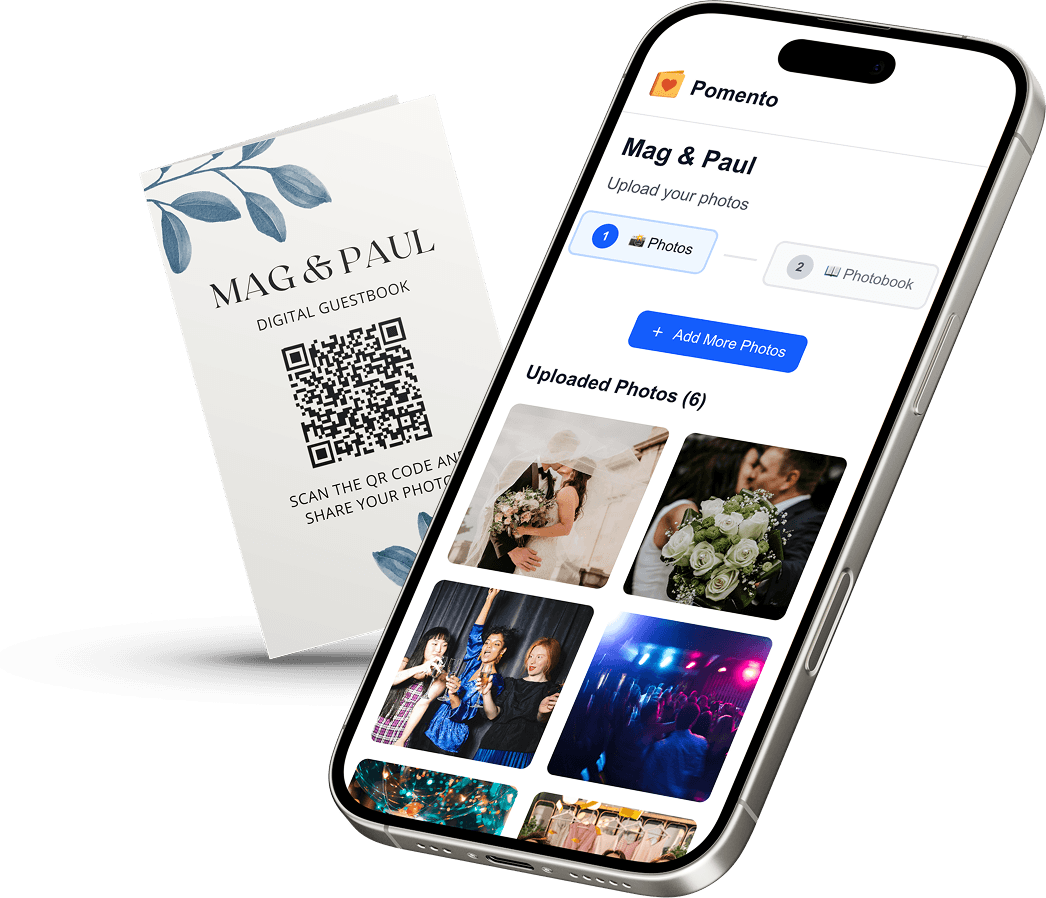
A digital guest book that becomes a book. Guests scan a QR code on a table card or on the invitation and add photos, videos, written messages and voice messages from any phone or computer. This works for people who cannot attend, such as grandparents overseas or friends who have already moved away. It also ends the “I’ll text you the photos” problem: everything lands in one place.
What we built for this: Pomento
Pomento is an all-in-one collaborative memory platform and digital guestbook for weddings, birthdays, baptisms, memorials, farewells and company events. The idea is simple: collect everyone’s memories in one place instead of scattered across phones and group chats, then turn them into a gift you can see, hear and hold. You can see the full list of occasions Pomento covers, graduations included.
For a graduation, here is how it works:
- Collect memories. You share a single QR code or link. Guests need only that one QR code or link. They do not install an app and do not sign up for anything. They upload photos, videos, written messages and voice messages from any phone or computer.
- Each guest designs a page. Every guest creates their own photo book page with their photos, words and voice message, using ready-made templates in a few taps. You do not do the layout.
- Receive the gift. Pomento brings the pages together into a Printed and Digital Photo Book (an interactive digital book to share online and a hardcover shipped to your door), a Personalized Song built from the guests’ words with its own Music Video, and a live Event Slideshow for screens and projectors. You can also download all the original photos, videos and voice messages.
It works two ways. Before the party, it is a shared surprise gift: parents, siblings and friends contribute in secret and the grad gets the finished book. During the party, it is a live guestbook, with guests adding photos and messages as the slideshow plays.
Pricing is a one-time payment with no subscription. The Digital Experience costs $48, and the Digital + Printed Book costs $87. There is no free trial, and every purchase comes with a 14-day money-back guarantee.

Want to see what the result looks like? Preview a real Example Photo Book on Pomento, or start your own project for free.
The same approach suits a retirement memory book for a coworker and a birthday photo book for a milestone, so if the graduation party also doubles as a family event, one setup can cover more than one gift.
Prompts that get real messages
Whether you use paper or digital, the messages carry the book. Here are prompts sorted by who is answering.
For parents and grandparents
- What do you remember about the day they were born, or the day they started school?
- What moment made you realize they were growing up?
- What do you want them to carry with them?
For friends and teammates
- What is the funniest thing we ever did?
- What will you miss most about seeing them every day?
- Where do you picture them in ten years?
For teachers and coaches
- When did you first notice something special about them?
- What is one thing they should keep doing?
For the graduate
- Favorite class, hardest week, proudest moment.
- Three things you want to do in the next chapter.
Tell contributors a rough length, two or three sentences, and a deadline. A reminder a few days before the deadline does more than any design choice, because most contributors are not unwilling, just busy.
Make it personal without making it complicated
A few small touches carry a lot of weight:
- Put the graduate’s name, school colors or a hobby symbol on the cover.
- Include the date and place of the graduation on the cover or title page.
- Add a handwritten note or a short list such as “10 things we love about you” in the family’s own style.
- Scan a diploma cover, a ceremony program, an acceptance letter or a ticket and place it on a page.
- Add a favorite quote from the graduate, a song they played on repeat, or a motto from the team.
If the graduation is a college or later milestone, ask partners and friends from that chapter, not only family. For a grad who is moving away soon after, include a page of “where to find us” photos from home.
Keeping the book for decades
A graduation book is built to be opened again at 30 or 50. A few storage habits protect a printed one.
The National Archives advises keeping scrapbooks in cool, dry conditions, flat and away from sunlight, turning pages carefully with clean hands, keeping food and drink away, and making a digital copy so the original is handled less. Damp can encourage mold and attract insects, and heat can make paper and adhesives brittle.
The Library of Congress recommends wrapping albums in acid-free paper and storing them in a protective box, which also shields them from airborne pollutants that harm paper and photographic prints.

In practice: keep the book on a shelf in a bedroom or living room closet rather than in an attic or basement, lay it flat, and keep the digital copy and original files in at least two places.
FAQ
What should I put in a graduation memory book?
Include a dedication page, photos from different ages, graduation day, achievements and activities, and messages from family, friends and teachers. Finish with a section on what comes next. Keep it chronological or sort it by theme, and end with the ceremony either way.
How many photos do I need?
Fewer than you think. Choose the strongest photos from each stage and let each page breathe. A smaller, well-edited book is more thoughtful than one stretched to hold everything. If it is also a guest book, plan one to three photos per page so there is room to write.
How do I collect messages from people who can’t attend?
Send one link or QR code by text or email. With Pomento, guests do not need an app or an account, and they can add photos, videos, written messages and voice messages from any phone or computer. Each guest then builds their own page from a template.
Can I make a graduation book as a surprise?
Yes. Share the link only with contributors and ask them to keep it quiet. Pomento works as a shared surprise gift before the event, and you can show the live slideshow at the party and hand over the finished book afterward.
Is a digital or printed book better?
They do different jobs. A printed hardcover is something to hold, display and pass down, while a digital book can be shared with relatives anywhere and can include video and voice messages. Pomento’s Digital + Printed Book gives you both.
Sources
- Preserving Scrapbooks, National Archives
- Scrapbooks and Albums, Library of Congress Collections Care