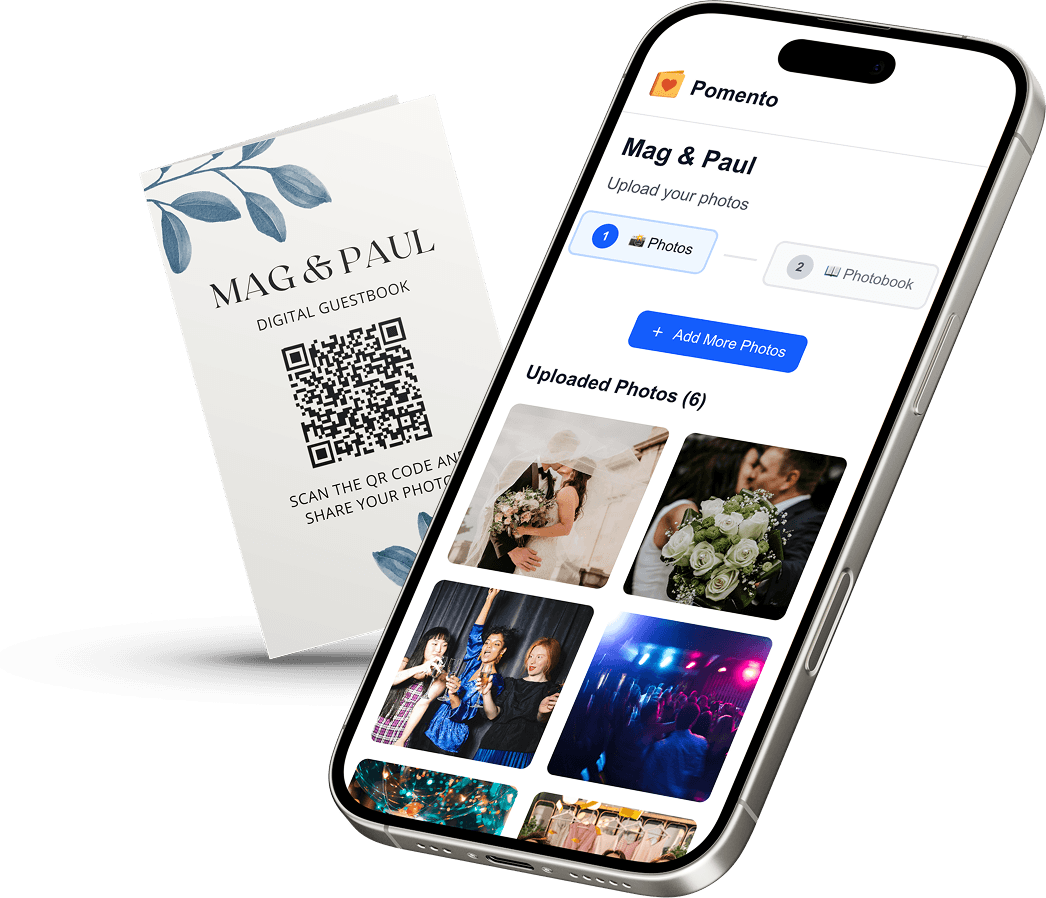
A celebration of life guest book is the record of who came to honor someone and what they wanted to say. The classic version is a bound book at the door. The version many families now choose is a shared online guest book that also collects photos, videos and voice messages from people who could not travel, then turns everything into a keepsake you can hold. This guide covers the formats, what guests can write, how to include faraway relatives, and how to pick the option that suits your family.
Key Takeaways
- A guest book records who attended and what they wrote. A tribute book tells the person’s life story. Many families now want both in one keepsake.
- A paper sign-in book works for the day itself, but it only captures the people in the room and gives most guests little space or time to write.
- An online memorial guest book lets distant relatives and friends contribute photos, videos, written notes and voice messages before, during or after the service.
- Pomento is an all-in-one collaborative memory platform and digital guestbook. Guests need only one QR code or link, no app and no sign-up.
- Give guests a few prompts. People write far better memories when they are asked a specific question.
Table of Contents
- What a celebration of life guest book is, and what it is called
- Why a celebration of life is different from a traditional funeral
- Guest book formats to consider
- What to write in a celebration of life guest book
- Including people who cannot be there
- What families can use instead of a traditional guest book
- How Pomento works as a celebration of life guest book
- Tips for a guest book people actually use
- Which option is right for your family?
- Pomento pricing and next steps
- Frequently Asked Questions
- Sources
What a celebration of life guest book is, and what it is called
A celebration of life guest book does the same job as a funeral guest book. It lists the names of the people who came, and it gives them a place to leave a message for the family. The difference is in the tone. A celebration of life usually puts stories, humor and gratitude ahead of formal mourning, and the book follows suit. Instead of only “signed in” lines, families want pages full of memories.
You will see the same object under several names: funeral guest book, memorial guest book, sign-in book, book of condolence, memory book and tribute book. They overlap, but there is a useful distinction. A guest book or sign-in book mainly records presence and short messages. A memorial tribute book or memory book tells the person’s life through stories, photos and milestones. One company’s guide to memorial books draws the same line between a guest book and a tribute book. In practice, a modern shared guest book can do both jobs, because the messages guests leave are the stories that fill a tribute.

Why families keep the book for years
The service passes in an afternoon. Grief does not. Months later, many people want to read what was said that day, find a photo they had never seen, or hear a voice again. A guest book that holds only signatures offers little of that. A guest book full of specific memories becomes something grandchildren will still open decades from now.
Why a celebration of life is different from a traditional funeral
A funeral is typically held soon after a death and follows a set structure. A celebration of life is more flexible. According to Dignity Memorial, a memorial service may take place days, weeks or months after a death. That flexibility matters for your guest book, because it means you have time to plan. You can invite contributions from far away well before the day, instead of scrambling at the door.
It also means the event can be built around the person. A celebration of life might be held in a backyard, a restaurant, a park, a club house or a place of worship. A heavy leather book on a lectern may suit one family. Another family may prefer a QR code on a table card and a slideshow playing on a screen. Neither is wrong. The right choice depends on who is coming and how you want to remember.
Guest book formats to consider
Families generally choose among four formats. Many combine two.
| Format | Best for | What it captures | Main limit |
|---|---|---|---|
| Traditional paper guest book | Small, in-person gatherings | Names, short notes | Only people in the room; little space to write |
| Loose-leaf or pocket book with cards | Larger services where guests write at their own pace | Names, longer notes, keepsake cards | Someone must collect and bind them afterward |
| Photo or memory table with a sign | Informal celebrations | Photos, objects, handwritten notes | Hard to preserve and share |
| Online collaborative guest book | Families spread across states or countries | Names, notes, photos, videos, voice messages | Guests need a phone or computer |
The traditional book
A bound guest book is familiar and dignified. Place it near the entrance with a pen on a cord, and ask a relative to point guests toward it. The risk is the queue. When 80 people arrive within 20 minutes, most sign their name and move on. You get a list, not stories.
Cards and loose pages
Some families set out cards with a prompt printed on each, such as “A time they made you laugh”. Guests take a card to their seat and hand it in later. This produces better writing, but the cards need to be gathered and arranged afterward, which is a lot to ask of a grieving family.

The online guest book
An online memorial guest book solves two problems at once. It reaches people who cannot attend, and it lets guests write in a quiet moment instead of in a line. Messages can arrive days before the service. They can be read aloud, shown on a screen, and kept afterward.
What to write in a celebration of life guest book
This is the question guests worry about most, and the answer is simpler than they fear. A good entry has three parts: who you are, one specific memory, and a closing wish.
- Say who you are. Add how you knew the person: “I worked with Dave for eleven years.” Relatives reading later will not recognize every name.
- Share one specific memory. “She taught me to drive stick on that hill behind the church” says more than “She was a wonderful woman.”
- Close with a simple wish. “We will keep telling that story” or “Thinking of you all” is enough.
Prompts you can print or share
If you want fuller entries, give guests a question to answer. Try one of these:
- What is the first thing you think of when you hear their name?
- What did they teach you, without meaning to?
- What was their laugh like, or their favorite saying?
- Which meal, song or place will always remind you of them?
- What would you want the family to know about what they meant to you?
When words will not come
Some guests freeze. Tell them a short note is welcome. “You were loved, and you will be missed” is a complete entry. For people who find writing hard, a voice message is often easier, because they can simply talk as if the person were in the room. If you want to see how spoken messages work at an event, our guide to the audio guest book explains what to say and how it is collected.
Including people who cannot be there
At almost every celebration of life, someone is missing for good reasons: a long flight, health, work, a new baby, a visa. Those are often the people with the longest history with the person being honored, such as a school friend in another country or a former neighbor who moved away. An online guest book lets them take part.
Here is how families usually do it:
- Share the link early. Send it in the same message as the service details, or in the family group chat, so remote friends can write ahead of time.
- Keep the ask small. “Add a photo or a memory whenever you like” works better than a formal request.
- Offer two ways to contribute. Some people prefer typing, others prefer a voice message.
- Keep it open a little after the event. Many people write only after the service, once the first shock has settled.
- Share the finished book. Everyone who contributed should receive the result, which closes the circle.
What families can use instead of a traditional guest book
If a paper book does not feel right, you have options that still do the job:
- A QR code on table cards or a program. Guests scan it with a phone and add their message from anywhere in the room.
- A shared online album. Easy to start, but usually just a pile of photos with no messages or order.
- A memory jar or card box. Guests write on slips of paper. Charming, but only the people present take part.
- A video or audio booth. A phone on a stand, set to record short messages. Lovely, though someone must look after it.
- A slideshow playing during the gathering. This is a way to show memories, not collect them, but it pairs well with any of the above.
The weakness of most of these is that they stay separate. Photos are in one place, notes in another, voice messages in a chat thread. That is the problem collaborative memory platforms are built to fix.
How Pomento works as a celebration of life guest book
Pomento is an all-in-one collaborative memory platform and digital guestbook for weddings, birthdays, baptisms, memorials, farewells and company events. The idea is simple: collect everyone’s memories in one place instead of leaving them scattered across phones and group chats, then turn them into a gift you can see, hear and hold. For a memorial or funeral, it works like this.
- Collect memories. You share one QR code or link. Guests need no app installation and no sign-up. They upload photos, videos, written messages and voice messages from any phone or computer.
- Design a page. Each guest creates their own photo book page with their photos, words and voice message, using ready-made templates in just a few taps. Nobody in the family has to lay out a book.
- Receive the finished keepsake. Pomento brings the pages together into a Printed and Digital Photo Book, a Personalized Song made from guests’ words with its own Music Video, a live Event Slideshow for the celebration, and downloads of all original photos, videos and voice messages.
Pomento works in two moments. Before the event, it can be a shared surprise or tribute that relatives build together. During the celebration, it works as a live guestbook: put the QR code on a table card, and guests add their memories while the slideshow plays on a screen. You are not left with a bare file download, but with a book you can hold, a book you can share online, and a song that carries the words people chose.
Why this suits a gathering that is already hard to organize
A family planning a celebration of life is making dozens of decisions in a short time. A guest book that needs no accounts, no downloads and no layout work removes three small burdens. Older relatives can take part by scanning a code. Younger ones can add a clip in a minute. The person organizing does not need design skills.
Tips for a guest book people actually use
Make it visible
Put the paper book or QR code where people naturally pause: the entrance, the memorial table, the refreshment area. Add a short line such as “Scan to share a memory of Anna”. Have a family member mention it in their opening words.
Ask in advance
The best entries are written with time. Share the link a week or two before when you can. People search their photo libraries and remember stories when they are not standing in a crowd.
Include every generation
Children and teenagers often have the most honest memories. A voice message from a grandchild can be the part the family replays most. Invite them directly, with a parent’s help for young ones.
Think about the final keepsake
Decide early whether you want one book for the immediate family or copies for several households. Some families add a printed copy for a parent or sibling who will treasure it most. Plan it before the service so there is no rush afterward.
Be gentle about the tone
A celebration of life welcomes laughter. Still, tell guests there is no right way to write. Short, funny, tearful and formal entries all belong.
Which option is right for your family?
Use this quick guide.
- Small, local gathering of around 30 people: a bound paper book with a few prompt cards is enough.
- Larger service or guests spread across the country: use an online guest book with a QR code so people can write in comfort and distant friends can join.
- You want to hear voices as well as read words: choose a format with voice messages, so a laugh or a familiar phrase is preserved.
- You want something to hold afterward: pick a platform that prints a hardcover book from the contributions, instead of doing it by hand.
- You are short on time: pick one that handles layout for you.
Pomento pricing and next steps
Pomento is a one-time payment with no subscription. There are two options:
- Digital Experience: $48, one-off.
- Digital + Printed Book: $87, one-off.
There is no free trial, but every purchase comes with a 14-day money-back guarantee. To see what guests and families receive, preview a real Example Photo Book on Pomento, or start your own project when you are ready. If you are weighing options for different kinds of gatherings, the occasions overview shows how the same approach works for other events.

To begin, choose the Digital Experience or the Digital + Printed Book and share your QR code or link with family and friends. Guests can upload photos, videos, written messages and voice messages from any phone or computer, with nothing to install and nothing to sign up for.
Frequently Asked Questions
What is a memorial book called?
The most common names are funeral guest book, memorial guest book, sign-in book, book of condolence and memory book. A guest book mainly records names and short messages, while a tribute book tells the person’s life story. Many families now combine both in one shared keepsake.
What should I write in a celebration of life guest book?
Say who you are and how you knew the person, then share one specific memory and close with a short wish. A single sentence is fine. If you find writing hard, a voice message in an online guest book can be easier.
What can I use instead of a guest book?
You can use table cards with a QR code, a memory jar, a recorded video or audio corner, or a shared online guest book. A collaborative online option has the advantage of keeping photos, notes and voice messages together. It also lets people who cannot attend contribute.
How do I collect memories from people who cannot attend?
Send an online guest book link in the same message as the service details, and keep it open for a while afterward. With Pomento, guests need only the link or QR code, with no app and no sign-up. They can add photos, videos, written messages or voice messages from any phone or computer.
When is a celebration of life held?
There is no fixed timing. A memorial service may be held days, weeks or months after a death, which gives families time to gather memories first.
Sources
- Memorial Book Ideas and What to Write Inside
- Memorial Service vs. Traditional Funeral vs. Celebration of Life, Dignity Memorial