The best birthday photo book is not a folder of pictures printed on paper. It is a story about one person, told partly by you and partly by the people who love them. Pick a clear theme, choose photos that show who they are, and ask friends and family for one specific memory each. Then lay it out with plenty of white space and print it in hardcover if it marks a milestone.
This guide walks through ideas by age, how to organize the book, what to ask guests, and how to collect everything without chasing people through group chats.
Key Takeaways
- Choose one theme (a timeline, a year of firsts, then and now) before you pick a single photo. The theme decides what stays out.
- Mix big milestones with small, ordinary moments, and ask each guest for one specific memory rather than a general wish.
- Keep captions short and layouts airy. Hardcover suits milestone gifts; softcover suits casual ones.
- A shared link or QR code lets guests add photos, videos, messages and voice notes with no app and no sign-up.
- Start the collection two to three weeks before the party so contributions are in before you design or order.
Table of Contents
- Birthday photo book ideas by age and relationship
- How to organize the book: timeline, theme or both
- Choosing which photos to include
- Make the pages readable: layout, captions and text
- What guests should write: prompts that get real memories
- How to create a birthday wishes book with photos from friends and family
- Hardcover, softcover, matte or gloss
- Making it a surprise: how Pomento handles birthday photo books
- Timeline: when to start
- Common mistakes to avoid
- Beyond birthdays: related books
- FAQ
- Sources
Birthday photo book ideas by age and relationship
The right idea depends on who the book is for and how many people are contributing. These are formats that work, grouped by occasion.
First birthday: a year of firsts
A first birthday book is usually made by parents for the child to read years later. A “year of firsts” format follows the months: first smile, first solid food, first steps. Add a page for each grandparent and godparent with a wish for the child. Writing now, in the voice of the people who were there, is what makes it valuable in 20 years.
Sweet 16, 18 and 21: becoming you
Teen and young adult birthdays suit a “becoming you” theme: school highlights, friendships, sports, trips and a page about goals. Friends are the best contributors here. Their inside jokes and photos from the last few years are things a parent would never have. A page where guests offer one piece of advice for the next chapter adds a forward-looking ending.
30th, 40th, 50th and 60th: then and now, or decades of you
For adult milestones, two structures work well. “Then and now” pairs an old photo with a recent one of the same person, place or group of friends. “Decades of you” gives each decade a spread. Travel, hobbies, career moments and relationships are the usual building blocks, because they show how far the person has come, not just how old they are.
If you are planning this kind of group gift, our birthday guestbook and photo book page shows how the collection works for milestone birthdays.
A tribute for a parent or grandparent
For an older relative, build the book around family. A simple family tree, photos of the house they grew up in, favorite recipes in their handwriting, and short stories from each grandchild turn the book into something the whole family wants a copy of. Voice messages matter even more here: hearing a grandchild say “happy birthday” is something a printed page cannot do alone.
The funny book
Some people would hate a sentimental book and love a roast. A book of their most questionable haircuts, worst photos and legendary mishaps, each with a one-line caption from a friend, is a real birthday gift. Keep it affectionate. Photos that mock the person should still make them look loved.
How to organize the book: timeline, theme or both
The simplest structure is chronological: early memories first, then life stages, then recent highlights, so the reader feels time passing. It is easy for contributors to understand and easy for you to sort.

A hybrid works better for most adults. Run the bulk of the book in order, then drop in thematic spreads: all the road trips together, every pet they have had, the friends who have been at every party. The break in rhythm keeps pages from feeling repetitive.
A quick structure you can adapt:
- Opening spread: a portrait and one sentence about why this book exists.
- Early years: childhood and family photos, if you have them.
- Middle chapters: school, work, relationships, hobbies, travel.
- Thematic spreads: pets, food, friends, running jokes.
- Guest pages: one page per contributor, with their photos, words and, where possible, a voice message.
- Closing page: a wish for the year ahead, or a group photo from the party.
Choosing which photos to include
You will have far more photos than pages. Use the story as a filter: each photo should show growth, change or personality. Mix major milestones (graduations, weddings, big trips) with small, meaningful moments like a kitchen-table laugh or a Sunday walk.
A few practical rules:
- Balance candid and posed. A few well-lit portraits and one group photo anchor a book otherwise made of candid shots.
- Cut near-duplicates. Pick the best of five similar shots.
- Add texture. Ticket stubs, handwritten cards and recipe cards, photographed or scanned, give a book character beyond the pictures.
- Check the quality. Old prints can be scanned; the Library of Congress publishes guidance on personal digital archiving, including how to scan and preserve family photographs and other personal collections.
Also ask for original files, not screenshots or photos sent through chat apps, which are often compressed. That matters if the book will be printed.
Make the pages readable: layout, captions and text
A good page lets one photo breathe. Use a full page for the standout pictures and collages for the smaller moments. Clean backgrounds, white space and one or two simple fonts keep attention on the person, not the design.
On captions, restraint wins. A reader tires quickly if every image carries a description. Add text where it gives context the photo cannot: who is in the picture, where it was, why it mattered, or the punchline of the story. Skip captions that simply describe what is already visible.
If your book includes longer passages, such as written messages from guests, give them their own pages or generous space around them. Matte paper tends to suit text-heavy pages because it does not reflect light.
What guests should write: prompts that get real memories
The most common problem with group books is the message that says “Happy birthday, hope it’s a great one!” It is kind, but it is forgettable. The fix is the prompt you give. Ask each person for one specific memory. Specific beats general every time.
Prompts you can send in your invitation to contribute:
- What is the first thing you remember about meeting them?
- Describe a moment when they made you laugh until it hurt.
- What is something they taught you without meaning to?
- What do you hope for them in the next year, or the next decade?
- Send a photo that shows who they really are, and tell us the story behind it.
For guests who hate writing, offer a voice message. Many people say more in 30 seconds of talking than in a paragraph of typing, and the recording captures their actual voice, which is the part families treasure most.
How to create a birthday wishes book with photos from friends and family
The hard part of a group book is not design. It is collection. Photos sit on twenty different phones, messages arrive by text, email and DM, and someone always sends their contribution the night before you need it.
A workable process:
- Set the deadline first. Work back from the birthday. Collection takes about two weeks, then you need time to review and, for a printed book, production and shipping.
- Build the guest list. Include friends, family, coworkers, and anyone far away who would love to be part of it.
- Send one link. Every extra step (downloading an app, creating an account, remembering a password) loses contributors. One link or QR code that works on any phone or computer gets far more responses.
- Share your prompts so people know what you are after, and give a deadline a few days before your real one.
- Nudge once or twice. A short reminder with the link included is enough.
- Review and order. Check that every contribution is in, then finalize the book.
Hardcover, softcover, matte or gloss
Format affects how the book feels, and how long it lasts.
| Choice | Best for | Notes |
|---|---|---|
| Hardcover | Milestone birthdays, permanent keepsakes | Sturdier; feels like a gift worth keeping |
| Softcover | Casual or lighter projects | Lighter and easier to mail or hand out |
| Matte paper | Books with longer passages of text | Non-reflective and resists fingerprints |
| Gloss paper | Photo-heavy books | Colors look more vivid and details sharper |
| Layflat binding | Panoramic or two-page images | Opens completely flat so a picture can cross the center |
For a 40th, 50th or 60th, or anything a family will pass down, hardcover is the usual choice.
Making it a surprise: how Pomento handles birthday photo books
Pomento is an all-in-one collaborative memory platform and digital guestbook for weddings, birthdays, baptisms, memorials, farewells, and company events. The idea is simple: collect everyone’s memories in one place instead of scattered across phones and group chats, and turn them into a gift you can see, hear and hold.
For a birthday, it works as a shared surprise gift before the party and as a live guestbook during the celebration. Here is how it goes:
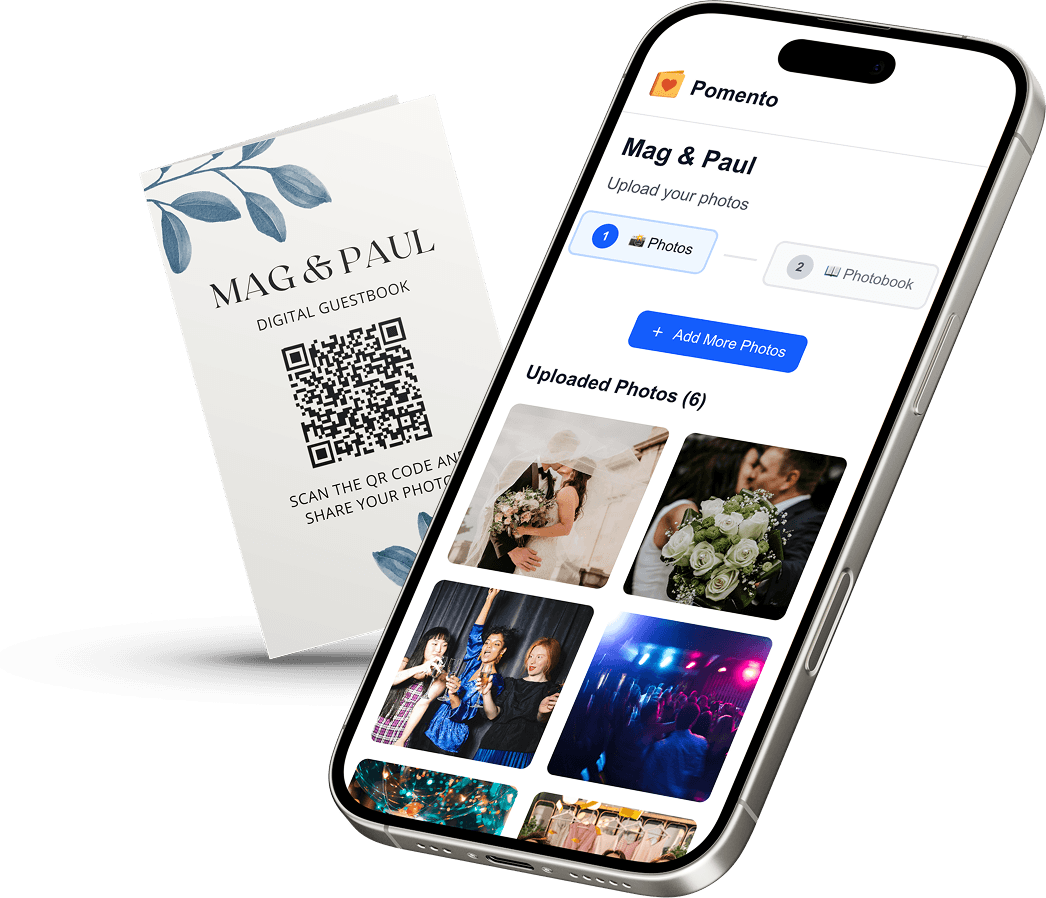
- Share one QR code or link. Guests need only that. There is no app to install and no sign-up.
- Guests contribute. They upload photos, videos, written messages and voice messages from any phone or computer.
- Each guest designs their own page. Using ready-made templates, every guest creates a photo book page with their photos, words and voice message in just a few taps.
- Pomento assembles the gift. You get a Printed hardcover and Digital Photo Book, a Personalized Song built from your guests’ words, a Music Video made from the photos, and an Event Slideshow for screens and projectors at the party. You also get downloads of all the original photos, videos and voice messages.
That last point is what separates it from a file download: the result is something you can hold, play and share, not only store.
Pricing is a one-time payment, with no subscription. The Digital Experience is $48, and Digital + Printed Book is $87. There is no free trial, but every purchase comes with a 14-day money-back guarantee.

Want to see what a finished book looks like? Preview a real Example Photo Book on Pomento, or start your own project there and share the link with guests. If you are planning more than one celebration, the occasions page covers everything from weddings to company events.
Timeline: when to start
A relaxed schedule for a milestone birthday:
- Four to six weeks out: pick the theme, build the guest list, decide on a format.
- Three weeks out: send the link with your prompts and a clear deadline.
- One week out: send a reminder and fill gaps yourself, for example with scans of old photos.
- Before the party: finalize pages; set up the slideshow if guests will watch it live.
- After the party: add party photos from guests, then order the printed copy.
If the birthday is closer than that, shorten each step. A last-minute book is still possible, but it depends on guests moving fast, which is why a single no-signup link matters.
Common mistakes to avoid
- Too many photos, too little story. Cut until every page earns its place.
- Only the host’s perspective. The most moving pages are often from someone you did not expect.
- Low-resolution images. Ask for originals, not chat-app copies.
- No deadline. Without one, contributions trickle in until the last hour.
- Skipping names. A message without a name, or a photo without context, loses half its value. Ask people to say who they are and how they know the guest of honor.
Beyond birthdays: related books
The same approach works for other milestones. Our guides to a graduation photo book and to wedding guest books with photos cover the same collect, design and print process. If you want to capture voices as well as pictures, see how an audio guest book works. For christenings, there is a dedicated baptism page, and for tributes to a loved one, our memorial page. Browse more ideas on the Pomento blog.
FAQ
What should I put in a birthday photo book?
Choose photos that show the person’s growth, personality and relationships, and mix big milestones with small everyday moments. Add a few messages from friends and family, ideally each telling one specific memory. Ticket stubs, cards or recipes can add texture.
How many photos does a birthday photo book need?
There is no fixed number. Plan around pages instead: one standout photo per full page, and three to five on collage pages. Fewer, better photos with a clear story beat a crowded book.
How do I get friends and family to contribute?
Send one link or QR code, tell them exactly what to share, and set a deadline a few days before your real one. Contributions rise when guests do not need an app or an account. Offer voice messages for people who dislike writing.
Is a hardcover birthday photo book worth it?
For milestone birthdays and keepsakes meant to last, hardcover is the usual choice because it is sturdier and feels like a lasting gift. Softcover suits casual projects. Pomento’s Digital + Printed Book is $87 and includes a 14-day money-back guarantee.